Blog XPS Foam Board
Types of Foam Insulation: EPS, XPS, Polyiso, Spray Foam and Cork Compared
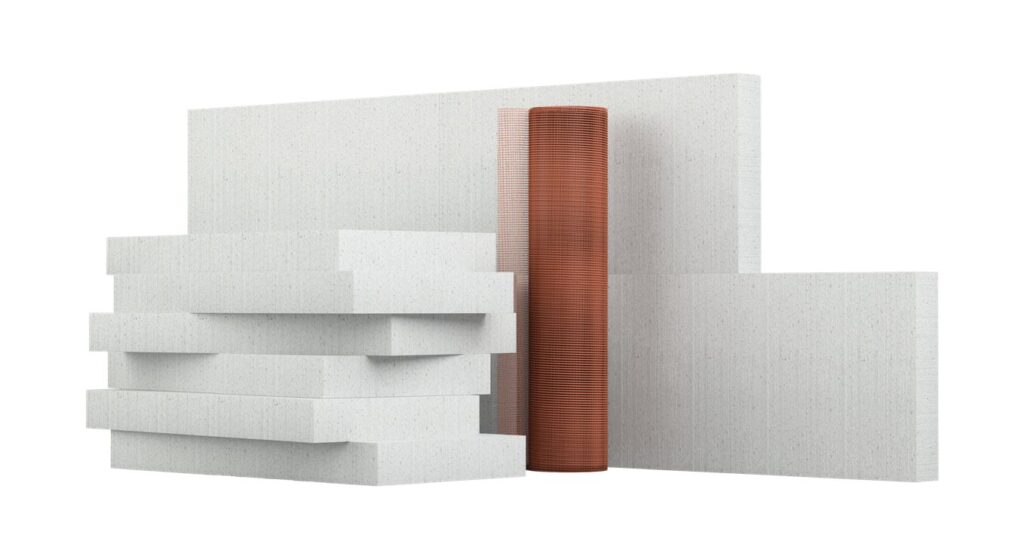
“Foam insulation” is not one product. It covers at least seven materials that are made differently, behave differently in water, lose or hold their R-value differently, and cost very different amounts for the same thermal result. Two of them are the same polymer with different manufacturing. One of them is tree bark.
Specify the wrong one for the assembly and the failure is rarely dramatic. The board stays where you put it and quietly underperforms, or it takes on water over fifteen years and gives back a third of the R-value you paid for, with nothing visible from the outside.
This is the full comparison: what each type is, the numbers that matter, and where each one belongs in a building in climate zone 7. We sell XPS, so read the sections where XPS loses with that in mind. We have marked them clearly, because a comparison that has our product winning every row would not be worth your time.
The four questions that decide it
Every foam argument comes down to four properties. Rank them for your assembly and the material usually picks itself.
- R-value per inch. How much thermal resistance you get per inch of thickness. This matters most where space is tight, and least under a slab where you can add thickness for the price of a deeper excavation.
- Behavior in water. Not just how much a board absorbs, but whether it gives the water back. This is the single most under-weighted property in residential specification, and it is the one that decides below grade.
- Compressive strength. Measured in psi at 10 percent deformation. Irrelevant in a wall. Decisive under a slab, under a footing, or under a driveway.
- Embodied carbon. What the material cost the atmosphere before it arrived. This used to be ignored and is now the fastest moving part of the conversation, mostly because of blowing agents.
A fifth property, air sealing, belongs only to the sprays, and it is the reason they exist.
EPS: expanded polystyrene
EPS is the white board that looks like a coffee cup up close, because it is made the same way. Polystyrene beads are expanded with steam and pentane, then fused together in a block mold. The block is cut into sheets. Look at a cut edge and you can see the individual beads.
Those bead boundaries are the whole story of EPS, good and bad.
- R-value: roughly R-3.6 to R-4.2 per inch depending on density. Published under ASTM C578 like XPS, so the types are directly comparable.
- Water: the standard allows 2 to 4 percent absorption by volume. The bead boundaries give water a path.
- Compressive strength: from about 10 psi for Type I up to 25 psi for Type IX.
- Blowing agent: pentane, which has a global warming potential close to nothing. Most of it is captured or burned off at the plant.
Where EPS wins, and it genuinely does: cost per unit of R-value, and embodied carbon. On both of those EPS beats conventional XPS and it is not close. It is also more vapor open, which is sometimes exactly what an assembly wants. If you are insulating above grade, in a dry location, on a budget, EPS is often the correct answer and anyone who tells you otherwise is selling something.
Where it loses: anywhere it will meet sustained moisture. The absorption figure understates the problem, because EPS is also slow to dry and the R-value loss persists while it is wet.
GPS: graphite polystyrene
GPS is EPS with graphite added to the beads, which is why the board is grey rather than white. The graphite reflects radiant heat inside the cell structure, and that lifts the R-value without changing the manufacturing much.
Expect around R-4.7 per inch, which closes most of the gap to XPS while keeping the low-GWP pentane blowing agent. Neopor is the best known trade name. The moisture behavior is still EPS behavior, because the bead structure has not changed, so this is a better above-grade board rather than a below-grade one.
It is worth knowing about because it is the most underused product in this list in our market. If your only objection to EPS was R per inch, GPS answers it.
XPS: extruded polystyrene
Same polymer, different process. Instead of fusing beads, the polystyrene is melted, mixed with a blowing agent and forced through a die as a continuous sheet. The result has no bead boundaries at all: a closed cell structure that is uniform the whole way through. Cut it and the face is smooth rather than beaded.
- R-value: R-5 per inch, aged, under ASTM C578.
- Water: the standard caps absorption at 0.3 percent by volume and real boards test lower. That is roughly ten to twenty times better than EPS.
- Compressive strength: commonly 15, 25, 40, 60 and 100 psi, which is the widest structural range of any board here.
- Blowing agent: historically the problem. See below.
Where XPS wins: below grade, under slabs, and anywhere compressive strength and water resistance have to coexist. The combination of 0.3 percent absorption and 100 psi availability is not matched by anything else on this list.
Where it loses, honestly: embodied carbon, historically and badly. Conventional XPS has been blown with HFCs, and HFC-134a carries a global warming potential in the region of 1,400 times carbon dioxide. For years that made XPS the worst mainstream insulation choice on a carbon basis despite being the best on performance. That is changing, and the detail matters enough to have its own section further down.
Polyiso: polyisocyanurate
Polyiso is a different chemistry altogether, a rigid foam faced on both sides with foil, glass or paper. It is the highest R per inch of the common boards and it dominates commercial roofing.
- R-value: labeled around R-5.6 to R-6 per inch, published as LTTR, a long term value that already accounts for the gas slowly leaving the cells.
- Water: poor. Polyiso absorbs and holds water, the facers can delaminate, and a wet polyiso board does not recover. It does not belong below grade or under a slab.
- Compressive strength: typically in the 20 to 25 psi range.
The cold climate asterisk, which matters more here than anywhere. Polyiso loses R-value as it gets cold, and this is not a fringe claim. Research cited by the NRCA and Building Science Corporation has shown boards around R-5.7 per inch at a 75 degree mean temperature falling to roughly R-4.8 per inch at 25 degrees.
Be careful with how far you take that, because the size of the effect is genuinely disputed. Owens Corning has published a figure as severe as R-2 at 15 degrees, a 66 percent loss. Energy Vanguard, reading the same Building Science research, puts the loss nearer 25 percent. Building Science Corporation’s own 2013 work found some products holding above R-5.5 across the whole range from 25 to 75 degrees, which says the behavior is product specific rather than universal. A 2020 IIBEC paper argues the concern is overstated because a labeled R-value already represents an average across a temperature gradient.
What to do with that disagreement: do not assume the label value applies on the coldest night of a Duluth January, do ask the manufacturer for temperature-dependent data on the specific product, and do not use polyiso as the only exterior insulation on a wall in zone 7 without checking it. The honest summary is that polyiso is excellent in a roof assembly, questionable as the outermost layer of a cold climate wall, and wrong underground.
Closed cell spray polyurethane foam
Sprayed as a liquid, expands on contact, cures rigid. Around two pounds per cubic foot.
- R-value: roughly R-6 to R-7 per inch, the highest in common use.
- Water and vapor: low absorption, and at around an inch and a half it becomes a vapor retarder in its own right.
- Compressive strength: structural, often 25 psi and up, and it adds racking strength to a wall.
- Air sealing: this is the real argument for it. It seals as it insulates, which no board can do without separate detailing.
Where it wins: rim joists, irregular cavities, retrofits where geometry is awkward, and anywhere air sealing and insulation need to be one operation. For a rim joist in this climate there is no better answer.
Where it loses: cost per R-value, by a wide margin. It is also a site-applied chemical reaction, which means the install quality depends on mix ratio, substrate temperature and the crew, in a way a board does not. Get it wrong and you get off-gassing, shrinkage or poor adhesion, and the remedy is removal. Blowing agents have historically been high GWP, and the industry has been moving to HFO systems for the same reason XPS has.
Open cell spray polyurethane foam
Same application method, very different material. About half a pound per cubic foot, soft, spongy, and open to vapor.
- R-value: roughly R-3.6 to R-3.8 per inch.
- Water and vapor: vapor open and water absorbent. It will let moisture through, which can be a feature if the assembly is designed to dry in that direction, and a serious defect if it is not.
- Air sealing: still good, which is the main reason to use it.
It is cheaper than closed cell and useful in attics and interior partitions, mostly for the air seal and for sound. It has no business below grade, in contact with concrete, or anywhere it can get wet.
Cork: expanded insulation corkboard
The outlier, and the most interesting material here. Expanded insulation corkboard, usually abbreviated ICB, is made from the bark of the cork oak, which regrows after harvest. The granules are steam expanded in a mold and bind using the tree’s own suberin resin, with no added glue.
- R-value: around R-3.6 to R-3.7 per inch. Amorim’s current datasheet lists thermal conductivity of 0.039 W/m·K, which converts to about R-3.7, matching the figure BuildingGreen published back in 2012.
- Density: about 110 kg per cubic meter.
- Durability: rot resistant, insect resistant, dimensionally stable, and it does not off-gas.
- Carbon: the manufacturer publishes a negative carbon footprint, supported by an environmental product declaration, with most of the plant’s energy coming from biomass.
Where it wins: embodied carbon, by a distance, and longevity. If carbon is the first ranked criterion on the project, this is the answer and nothing else is close.
Where it loses: price and availability. In the Northland it is a special order with a long lead time, and the cost per unit of R is several times the alternatives. It is a real material and a good one, and on most jobs in this market it does not get specified for reasons that have nothing to do with performance.
The one that is not foam: mineral wool
Mineral wool keeps appearing in these comparisons so it is worth placing. It is spun from molten rock or slag, not foamed from a polymer, so it is a different category. Expect roughly R-4 to R-4.3 per inch, non-combustible, vapor open, and it drains rather than absorbing.
It is a genuine competitor to foam board for exterior wall insulation, particularly where fire performance or vapor openness is the priority. It is not a candidate under a slab, because it compresses.
And “Styrofoam”, which is not a material
Styrofoam is a trademark, not a product category. In normal speech it gets used for the white bead board people are thinking of, which is EPS, and for the blue and pink extruded boards, which are XPS. The two behave very differently in water, so the word causes real specification errors.
We have written that up separately, with the moisture data, in Styrofoam against Eco Foam, what the word means and what the moisture data says.
The comparison, in one table
| Material | R per inch | Water absorption | Compressive psi | Best use |
|---|---|---|---|---|
| EPS | 3.6 to 4.2 | 2 to 4% | 10 to 25 | Above grade, budget, dry |
| GPS | about 4.7 | 2 to 4% | 10 to 25 | Above grade where R per inch matters |
| XPS | 5.0 | 0.3% or less | 15 to 100 | Under slab, below grade, slab edge |
| Polyiso | 5.6 to 6.0 labeled | High, does not recover | 20 to 25 | Roofs, above grade, never buried |
| Closed cell spray | 6.0 to 7.0 | Low | 25 and up | Rim joists, odd cavities, retrofit |
| Open cell spray | 3.6 to 3.8 | Absorbent | Non-structural | Attics, interior, sound |
| Cork ICB | 3.6 to 3.7 | Low | Moderate | Carbon-first projects |
| Mineral wool | 4.0 to 4.3 | Drains | Compresses | Walls, fire and vapor priorities |
Read that table as a starting point rather than a verdict. Every row has a condition attached, and the conditions are where the decisions live.
The blowing agent question, which is where the carbon is
For most of these materials, the biggest piece of embodied carbon is not the polymer. It is the gas used to foam it.
EPS and GPS use pentane, which has negligible global warming potential. Cork uses steam and the tree’s own resin. Those two have never had a blowing agent problem.
XPS and spray polyurethane did. XPS was commonly blown with HFC-134a, with a GWP around 1,400 times that of carbon dioxide, and that single fact made conventional XPS the hardest insulation to defend on a carbon basis.
That has been changing, and the picture is still moving:
- The EPA’s 2015 rule listed several HFCs used in XPS as unacceptable, with the change due to take effect on 1 January 2021.
- Owens Corning moved to a hydrofluoroolefin blowing agent and markets the result as Foamular NGX, stating it brought GWP from roughly 750 down to around 150.
- The EPA has continued to adjust the listings. A December 2024 action listed further XPS blowing agent blends, including HFO-1336mzz(Z), HFO-1234ze(E), HFC-152a and carbon dioxide, as acceptable.
The practical advice is simple: if embodied carbon is on your scorecard, ask the supplier what the board is blown with, and get the answer in writing. “XPS” on its own no longer tells you whether the carbon figure is terrible or respectable.
There is a second lever that gets less attention, which is recycled content. The board we make is manufactured with 85 percent post-consumer recycled polystyrene, which addresses the feedstock side of the same question rather than the blowing agent side. Both matter, and they are not substitutes for each other.
Which one belongs where, in a zone 7 building
This is the part a table cannot give you, because the right answer changes by assembly.
- Under the slab. XPS. Compressive strength and near-zero absorption in the same board, buried for the life of the building where nothing can ever be inspected or replaced. EPS is used here and it does work, but it is the place where the moisture difference compounds for fifty years. See under-slab insulation.
- Slab edge and the turndown. XPS again, and in zone 7 the code numbers are specific. We covered them in slab edge insulation in zone 7.
- Foundation walls, below grade. XPS. Polyiso and open cell spray are both wrong here, and EPS is a compromise.
- Above grade walls, outboard of the framing. Genuinely open. EPS, GPS, XPS, polyiso and mineral wool are all defensible. Decide on R per inch against budget, and on how you want the wall to dry. See continuous exterior insulation.
- Rim joists. Closed cell spray, or board cut in and sealed. This is the one place spray foam is clearly worth its cost.
- Roofs. Polyiso, where it is warm and dry and its R per inch is an advantage.
- Driveways, aprons and shop floors. XPS at 60 or 100 psi. Nothing else on this list carries a vehicle load at the thicknesses involved.
Frequently asked questions
What is the difference between EPS and XPS?
Both are polystyrene. EPS is made by expanding beads with steam and fusing them in a mold, which leaves bead boundaries. XPS is melted and extruded as a continuous sheet with no bead structure. The practical result is that XPS absorbs 0.3 percent water or less against 2 to 4 percent for EPS, and gives R-5 per inch against R-3.6 to R-4.2. EPS costs less per unit of R and has a much lower embodied carbon figure.
Which foam insulation has the highest R-value per inch?
Closed cell spray polyurethane, at roughly R-6 to R-7 per inch, followed by polyiso at a labeled R-5.6 to R-6. Both come with conditions: spray foam is the most expensive per unit of R, and polyiso loses R-value in cold weather, which matters in climate zone 7.
Is Styrofoam the same as XPS?
Styrofoam is a brand name, not a material. People use it for both the white bead board, which is EPS, and the colored extruded boards, which is XPS. The two behave very differently in water, so the word is a common source of specification errors.
Can you use polyiso below grade or under a slab?
No. Polyiso absorbs and holds water, its facers can delaminate, and it does not recover its R-value after wetting. Under a slab or against a foundation wall it is the wrong material. Use XPS there.
Does polyiso really lose R-value in the cold?
Yes, though how much is disputed. Research cited by the NRCA and Building Science Corporation shows boards falling from about R-5.7 per inch at 75 degrees to about R-4.8 at 25 degrees. Owens Corning has published a far steeper figure and Energy Vanguard a shallower one, and some products hold above R-5.5 across the whole range. Ask the manufacturer for temperature-dependent data on the specific product rather than trusting the label in January.
What is graphite polystyrene, and is it worth it?
GPS is EPS with graphite added to the beads, which reflects radiant heat inside the cell structure and raises the R-value to roughly R-4.7 per inch. It keeps the low-GWP pentane blowing agent of EPS. If your objection to EPS was R per inch and not moisture, GPS answers it.
Is spray foam better than rigid board?
Not better, different. Spray foam air seals and insulates in one operation, which boards cannot do without separate detailing, and it fits irregular cavities. Boards cost far less per unit of R, their quality does not depend on site conditions, and XPS outperforms spray foam below grade. Use spray where geometry or air sealing is the problem, and board where neither is.
Which foam insulation has the lowest carbon footprint?
Expanded cork, which the manufacturer publishes as carbon negative with a supporting environmental product declaration. Among the plastics, EPS and GPS are well ahead because they use pentane rather than a high-GWP blowing agent. XPS has historically been the worst on this measure, which is why the industry move to HFO blowing agents and to recycled feedstock matters.
Where to go from here
If the job is a slab, the two decisions that matter most are what goes under it and what shapes the edge, and we make and stock both in Duluth.
Our XPS foam board is R-5 per inch to ASTM C578-19, made with 85 percent post-consumer recycled polystyrene, in 40, 60 and 100 psi. Our insulated concrete slab forms stay in the pour, so the form becomes the edge insulation. For what belongs under the middle of the slab see under-slab insulation, and for the shallow footing detail see frost protection.
If you are weighing the foundation itself rather than the insulation, start with foundation types in a cold climate.
Sources
- ASTM C578, Standard Specification for Rigid, Cellular Polystyrene Thermal Insulation.
- ASTM C1289, Standard Specification for Faced Rigid Cellular Polyisocyanurate Thermal Insulation Board.
- ASTM C272, water absorption of core materials, and ASTM C518, steady-state thermal transmission.
- Green Building Advisor, “Cold-Weather Performance of Polyisocyanurate,” citing NRCA and Building Science Corporation testing.
- Building Science Corporation, 2013 research on temperature dependence of polyisocyanurate R-values.
- Taylor, IIBEC Interface, January 2020, on interpreting low-temperature polyiso R-values.
- US EPA, Significant New Alternatives Policy program listings for foam blowing agents, 2015 rule and December 2024 action.
- Green Building Advisor, “XPS Makers Announce More Planet-Friendly Formulations,” on the move to HFO blowing agents.
- Amorim Cork Solutions, expanded insulation corkboard technical datasheet and environmental product declaration EPD HUB-0281.
- BuildingGreen, “Expanded Cork: The Greenest Insulation Material?”